
Tips for dog owners to improve walks in busy neighborhoods.

Mastering the tours in lively neighborhoods It requires a sensitivity that goes beyond the simple act of holding a leash.
Advertisements
By 2026, Brazilian metropolises will have reached a level of noise and visual saturation that challenges even the most balanced dogs.
It's not just about "taking the pet out to pee," but about conducting a safe expedition through a hostile territory of concrete, hurried delivery people, and invisible chemical stimuli.
Walking through central areas requires an active approach. The tutor ceases to be a passive spectator of the route and becomes the mediator of a chaotic reality.
This guide proposes a technical and practical immersion to transform urban stress into functional urban coexistence.
Advertisements
Summary
- The psychological burden of urban verticalization.
- The anatomy of safety: equipment that doesn't fail.
- Reading signs: when a dog's silence is a warning.
- Strategic mapping of flows and schedules.
- The technique of focusing as an emotional anchor.
Why does the dynamic of modern urban life overwhelm a dog's instincts?
There is a profound disconnect between canine biology and the architecture of large cities.
Neighborhoods with high population density generate what we call a "canyon effect," where the sound from the avenues reflects off the facades of buildings, creating a confusing acoustic environment.
For an animal with acute hearing, this is not just noise; it's an overload of information that it cannot process linearly.
The result is a state of constant alertness. When cortisol levels rise, the animal's learning capacity drops drastically.
Therefore, insist on tours in lively neighborhoods Without an emotional support strategy, it is often counterproductive.
The tutor's role is to filter out this excess, serving as a stable point of reference amidst the frenetic movement of pedestrians and vehicles.
How do you build unwavering focus amidst chaos?
The secret to a peaceful walk lies not in physical strength, but in visual connection. Training your dog to voluntarily seek your gaze is the most powerful tool you can have.
Begin this practice in the quiet of the living room; the common mistake is trying to teach something new precisely when the environment is already saturated with distractions.
When leaving for the tours in lively neighborhoodsReward your dog every time he diverts his attention from a stimulus—such as a skateboarder or a bus—to look at you.
++ Tips for dog owners to deal with pent-up energy.
This split-second of eye contact interrupts the reactivity cycle. Over time, the dog understands that, when faced with uncertainty, the best decision is to consult its owner, not react to its surroundings.
Equipment: the difference between control and risk
On narrow, busy streets, the margin for error is minimal. Many people still use retractable curbs for a false sense of freedom, but in urban centers they are dangerous.
They reduce the tutor's reaction time and can cause serious accidents involving cyclists in fractions of a second.
The technical choice falls on fixed guides made of resistant material and harnesses with multiple adjustment points. Equipment that comes loose on a busy avenue is a disaster waiting to happen.
Invest in brass or stainless steel hardware, which can withstand sudden jolts if the animal is startled by something unexpected.
Read more: Tips for pet owners to keep their dog balanced in busy homes.
The equipment should be an extension of your communication, allowing for subtle directional adjustments without the need for brute force.
The silence that precedes reactivity.
Many owners ignore subtle signs of discomfort, assuming the dog is "behaving" just because it's not barking.
However, an animal that walks with a stiff body, ears back, or that repeatedly licks its snout is suffering internally.
Identifying these microbehaviors allows you to anticipate an outburst of fear or aggression.
If you notice that your partner is becoming breathless even when the weather isn't hot, or if they start to "freeze" in certain corners, respect that.
Excessive stimulation in tours in lively neighborhoods This can lead to a buildup of stress, where small annoyances add up until the emotional limit is reached.
Find out more: How to recognize signs of discomfort in more reserved dogs
Sometimes, the best training is simply knowing when to go home.
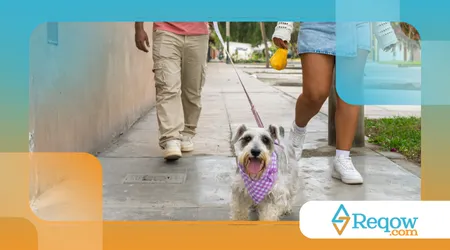
Urban Exhibition Planning
| Time Window | Environmental Dynamics | Strategic Objective | Recommended Approach |
| Early morning (5am – 7am) | Empty and Silent | Exploration and Lighthouse | Allow for deep and relaxed inhalation. |
| Business Hours (10am – 4pm) | Constant Flow | Focus Training | Short hikes with many rewards. |
| Peak (5pm – 7pm) | Saturated / Chaotic | Crisis Management | Avoid it unless the dog is resilient. |
| Evening (9pm – 11pm) | Moderate | Decompression | Walk at a slow pace to lower your alertness level. |
The strategic value of decompression breaks: walks in busy neighborhoods.
Not every minute of leisure time needs to be spent commuting. In dense neighborhoods, finding "islands of calm"—a driveway, a dimly lit plaza, or a wide sidewalk—is essential.
Stop for two or three minutes. Let the dog observe the movement without needing to interact with it.
This processing time helps the animal's brain understand that, despite the movement around it, it is safe.
Perform tours in lively neighborhoods Using strategic pauses teaches emotional self-regulation.
The dog learns that it can be in a noisy place and still remain calm, as long as it has this periodic support from its owner.
To deepen your understanding of pet psychology, visit the portal of World Small Animal Veterinary Association (WSAVA) It offers updated guidelines on how the urban environment impacts the mental health of pets.
Managing unexpected encounters on narrow sidewalks
Encounters with other dogs in busy neighborhoods are often tense due to the lack of space for the species' natural "approach curve."
When two dogs approach each other head-on on a narrow sidewalk, tension rises. If the other animal seems unsteady, don't hesitate to cross the street or use a parked car as a visual barrier.
There is nothing wrong with protecting your dog's space. Often, social pressure makes us allow strangers or other animals to approach, but in tours in lively neighborhoodsYour priority is the emotional well-being of your pet.
Saying "no" to an unwanted interaction is an act of responsibility and leadership.
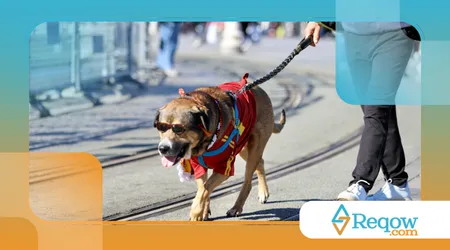
Smell: the canine brain's escape valve
While humans are guided by sight, dogs map the world through their noses. Preventing an animal from sniffing during its journey is like blindfolding a person in a museum.
Scent work is a low-energy physical activity, but it requires very high mental effort, which helps to balance the adrenaline caused by urban noises.
Even if the journey is short, allow him to explore the neighborhood's "information posts." This behavior stimulates the parasympathetic nervous system, promoting relaxation.
A dog that sniffs calmly during the tours in lively neighborhoods It tends to be much more peaceful at home, as mental fatigue is more rewarding than physical exhaustion.
Final Considerations
Living with a dog in a metropolis in 2026 requires constant adaptation. The success of daily outings doesn't depend on the absence of noise, but on the quality of your partnership with the animal.
By understanding biological limits and respecting your partner's processing time, you transform the asphalt into a field of mutual trust.
Every corner calmly navigated is a victory in training. With patience and the right tools, it's entirely possible to enjoy urban life without compromising the well-being of those on the other side of the curb.
For official guidelines regarding the transit and presence of animals in public spaces, please consult the website of Federal Council of Veterinary Medicine (CFMV), which regulates good management practices in Brazil.
FAQ – Frequently Asked Questions
Why does my dog seem to ignore treats when we're out and about?
This usually indicates that the stress level is too high. When the animal enters "fight or flight" mode, the digestive system shuts down and interest in food disappears. Retreat to a calmer location.
Is it safe to use a muzzle in very crowded places?
If your dog is reactive or feels insecure, a basket muzzle (Baskerville type) is an excellent safety device that allows him to pant and drink water, as well as signaling for people to keep their distance.
How to deal with the noise from construction and sirens?
Do not force your way through areas with sudden, extreme noises. If possible, take a detour or change your route. Forced exposure to traumatic sounds can lead to phobias that are difficult to overcome.